



PHP developers have been dealing with stream errors for a long time.
Reading a file, opening a socket, or working with a custom stream can look simple in code. But when something goes wrong, the error-handling experience has often been less convenient than developers would expect from a modern language.
A failed operation might return false. A warning might be emitted. In some cases, application code has to inspect the last PHP error to figure out what happened.
PHP 8.6 introduces a new approach to stream error handling that aims to make these failures more structured and easier to work with.
Instead of treating every stream problem as an unstructured warning message, the new API introduces dedicated error objects, enums, exception handling, and configurable stream contexts.
That is a meaningful improvement for developers who build filesystem tools, HTTP clients, libraries, and other applications that depend heavily on PHP streams.
Why Traditional Stream Error Handling Is Frustrating
Consider a typical file-reading helper:
function readFileContents(string $path): ?string
{
    $contents = @file_get_contents($path);

    if ($contents === false) {
        $error = error_get_last();

        if (str_contains(
            $error['message'] ?? '',
            'No such file'
        )) {
            return null;
        }

        throw new RuntimeException(
            $error['message'] ?? 'Unknown error'
        );
    }

    return $contents;
}
The function looks reasonable at first.
But there is a problem hidden inside it.
The application is trying to determine the cause of a failure by examining the text of an error message.
That is fragile.
A missing file, a permission problem, and another stream failure are different situations. Yet the application is relying on a human-readable string to tell them apart.
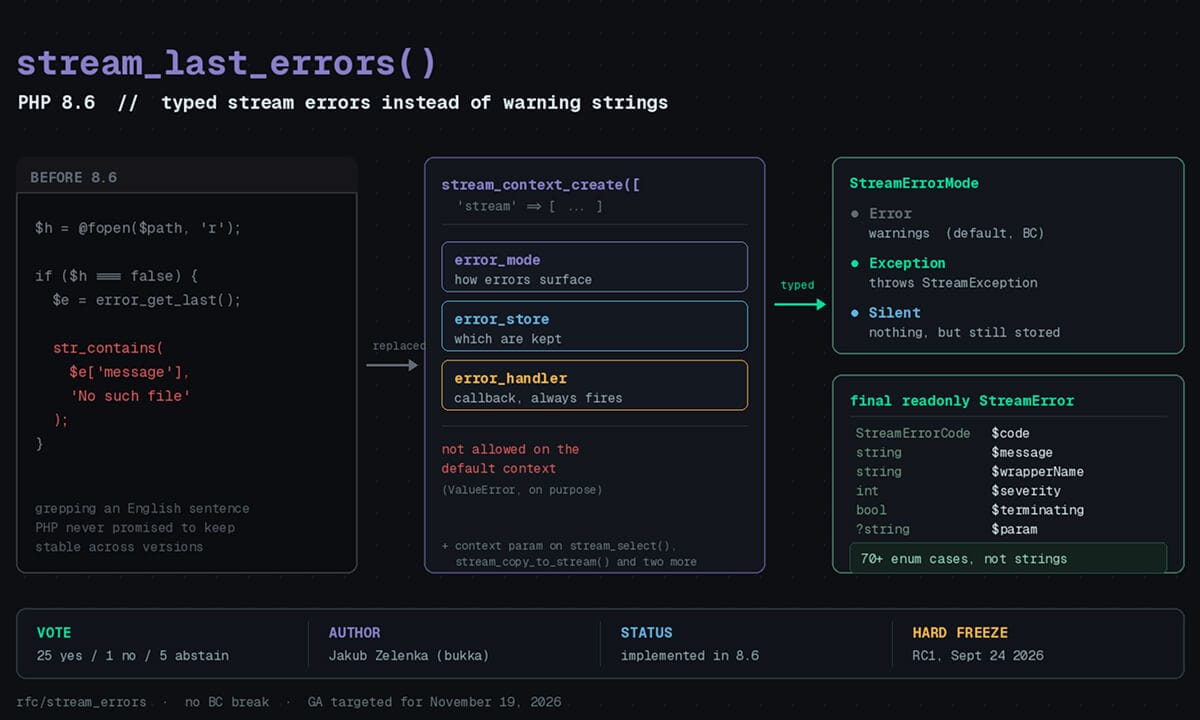
PHP 8.6’s Stream Error Handling Improvements RFC addresses this problem by providing structured stream errors instead of forcing developers to parse warning text.
The proposal was voted on in May 2026 and is marked implemented for PHP 8.6. <Cite refs={[“turn0search1″,”turn0search3”]}/>
A More Structured Error Model
The new stream API introduces several building blocks:
StreamErrorStreamExceptionStreamErrorCodeStreamErrorModeStreamErrorStorestream_last_errors()stream_clear_errors()
The goal is to make stream failures easier to identify, handle, and log.
For application developers, the biggest change is that an error can now carry structured information about what went wrong.
Instead of asking:
str_contains($message, 'No such file')You can work with a specific error code:
$error->code === StreamErrorCode::NotFoundThat is a much clearer way to express the intent of the application.
Choosing How Stream Errors Behave
The new API uses stream context options to configure error handling.
The main options are:
error_mode
This determines how stream errors are surfaced.
The RFC introduces:
StreamErrorMode::ErrorStreamErrorMode::ExceptionStreamErrorMode::Silent
The default behavior preserves the traditional warning and notice approach.
Exception mode allows terminating stream errors to be handled through exceptions.
Silent mode prevents errors from being emitted, allowing the application to inspect stored errors when configured to do so.
error_store
This controls which errors are retained for later retrieval.
The available enum cases include:
AutoNoneNonTerminatingTerminatingAll
This is useful when an application wants to distinguish between errors that stopped an operation and errors that did not.
error_handler
An optional callback can receive stream error information.
This creates a natural place for logging and monitoring without forcing every individual stream operation to implement its own error-reporting logic.
Handling a Missing File With Exceptions
For applications where a failed file operation should stop the current workflow, exception mode is a useful option.
The intended usage looks like this:
$context = stream_context_create([
    'stream' => [
        'error_mode' => StreamErrorMode::Exception,
    ],
]);

try {
    $handle = fopen(
        '/srv/app/report.pdf',
        'r',
        false,
        $context
    );
} catch (StreamException $e) {
    $errors = $e->getErrors();

    $first = $errors[0] ?? null;

    if (
        $first?->code === StreamErrorCode::NotFound
    ) {
        // Handle the missing file
    } else {
        throw $e;
    }
}
The important difference is that the application can inspect a structured error rather than searching through a warning string.
StreamException exposes the errors associated with the failed operation, while StreamError contains information about the individual error.
This gives library authors a more consistent foundation for handling filesystem and stream failures.
Not Every Failure Needs an Exception
Exceptions are useful, but they are not always the right choice.
Consider a cache lookup.
A missing cache file is often normal. The application can simply generate the value again.
In that situation, turning every cache miss into an exception may add unnecessary complexity.
Silent mode provides another way to handle the operation:
$context = stream_context_create([
    'stream' => [
        'error_mode' => StreamErrorMode::Silent,
        'error_store' => StreamErrorStore::All,
    ],
]);

$handle = fopen(
    $cachePath,
    'r',
    false,
    $context
);

if ($handle === false) {
    $errors = stream_last_errors();

    $first = $errors[0] ?? null;

    if (
        $first?->code === StreamErrorCode::NotFound
    ) {
        $this->warmCache($cachePath);
    } else {
        $this->logger->warning(
            'Cache operation failed',
            [
                'errors' => $errors,
            ]
        );
    }
}
The application can now treat an expected cache miss differently from an unexpected failure.
That distinction is particularly useful in frameworks and reusable packages.
One Operation Can Produce Multiple Errors
Another interesting part of the new design is the ability to retain more than one error from a single stream operation.
A stream operation may encounter multiple problems before it returns control to the application.
For example, a userspace stream used with stream_select() may encounter issues related to stream casting and file-descriptor support.
Rather than discarding one error and keeping only the other, the new API can expose a collection of errors.
$errors = stream_last_errors();

foreach ($errors as $error) {
    echo $error->code->name
        . ': '
        . $error->message
        . PHP_EOL;
}
This is valuable for debugging because the first reported problem is not necessarily the only useful piece of information.
Developers can inspect the complete set of errors and decide which ones matter to their application.
New Context Support for Stream Functions
The RFC also extends several stream-related functions with an optional context parameter.
The functions listed in the RFC include:
stream_select()stream_copy_to_stream()stream_socket_pair()stream_is_local()
This makes it possible to apply the new stream error configuration to operations that previously lacked a context argument.
For example:
$context = stream_context_create([
    'stream' => [
        'error_mode' => StreamErrorMode::Exception,
    ],
]);

try {
    stream_copy_to_stream(
        $source,
        $destination,
        null,
        0,
        $context
    );
} catch (StreamException $e) {
    $this->logger->error(
        'Stream copy failed',
        [
            'errors' => $e->getErrors(),
        ]
    );
}
The broader idea is to make error handling configurable across more of PHP’s stream API.
Why Explicit Contexts Matter
A major consideration is how the configuration is applied.
Stream error settings are intended to be configured through an explicit stream context rather than silently changing the behavior of every stream operation in the application.
That is important for compatibility.
A library may rely on the traditional behavior of returning false and emitting a warning. Another application may prefer exceptions.
If a global configuration unexpectedly changed all stream behavior, existing code could break in surprising ways.
Explicit contexts allow developers to opt into the behavior they need.
What Changes for Existing PHP Applications?
The new feature is designed to improve stream error handling without forcing existing applications to rewrite all their stream code immediately.
The traditional error mode remains the default.
That means developers can adopt the new API gradually, especially in code that needs reliable error classification or more structured logging.
Potentially useful areas include:
- Filesystem abstractions
- HTTP clients
- Storage libraries
- Cache systems
- Socket-based applications
- Framework internals
- Custom stream wrappers
For package authors, structured errors can reduce the need to maintain custom logic that interprets PHP warning messages.
A Better Foundation for PHP Libraries
One of the biggest benefits of this change may not be visible in a small application.
It is in the libraries that sit underneath thousands of applications.
A filesystem package should be able to distinguish a missing file from a permission failure without relying on the wording of an English warning.
An HTTP client should be able to classify connection errors consistently.
A storage adapter should be able to log useful error details without reconstructing the meaning of a warning message.
Structured stream errors provide a foundation for those use cases.
PHP 8.6 Release Status
The Stream Error Handling Improvements RFC is marked implemented for PHP 8.6.
PHP 8.6 development has included the new stream error API, along with other language and standard-library improvements.
As of September 2026, PHP 8.6 is in development, and the general availability target is November 19, 2026. Release dates can change, so developers should check the official PHP release information before planning a production upgrade. <Cite refs={[“turn0search0″,”turn0search1″,”turn0search3″,”turn0search7”]}/>
Final Thoughts
PHP streams are powerful, but error handling has not always been as expressive as developers would like.
The new PHP 8.6 stream error API moves the design toward a more structured approach.
Instead of relying on warning strings, applications can use error codes, dedicated objects, exceptions, and configurable contexts.
That is especially useful for developers building reusable libraries where predictable error handling matters.
The most important takeaway is simple:
PHP stream errors are becoming easier to classify, handle, and monitor.
And for developers who have spent years writing custom wrappers around fopen() and file_get_contents(), that is a welcome improvement.