



Docker vs Podman 🐳
At first glance, Docker and Podman look almost identical.
docker run nginx
vs.
podman run nginx
Same idea. Similar commands.
But under the hood, the architecture is quite different.
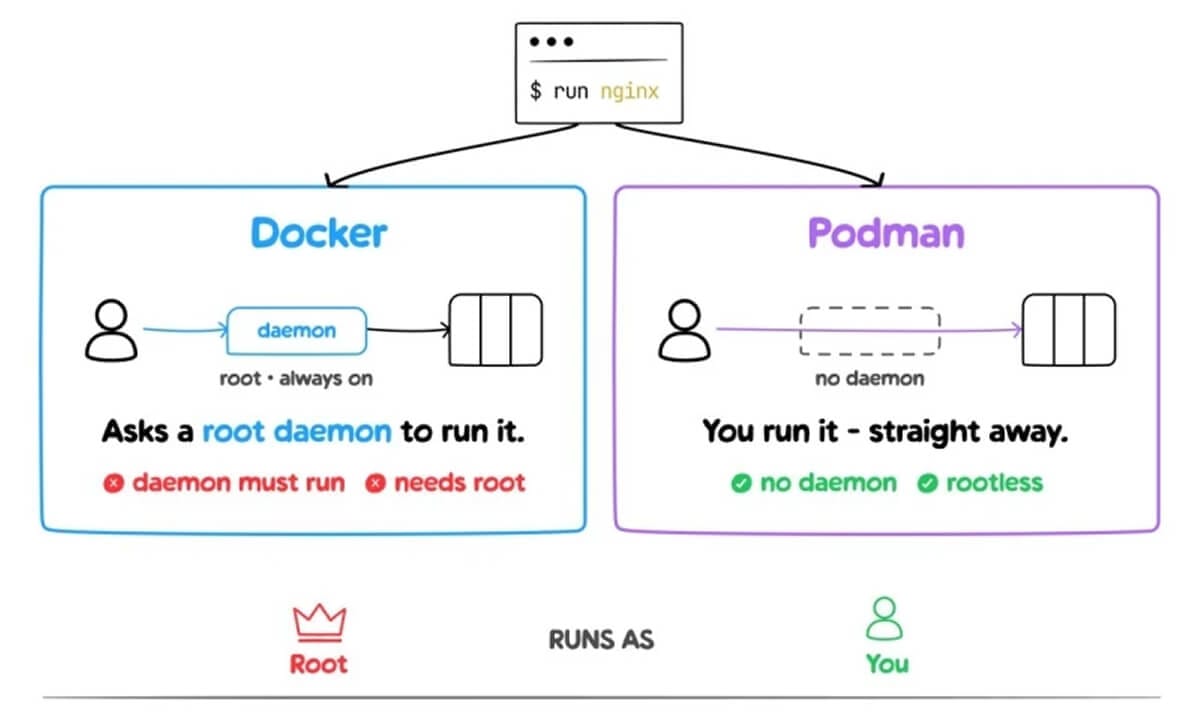
🔹 Docker: Client → Daemon → Container
With traditional Docker, your CLI communicates with the Docker daemon (dockerd).
The daemon is responsible for things like:
→ Creating and managing containers
→ Handling images
→ Managing networks and volumes
→ Starting and stopping workloads
So there is a central process sitting between you and the containers.
🔹 Podman: CLI → Container
Podman takes a different approach.
There is no permanently running central daemon required for normal container operations.
Your command can directly create and manage the container process.
That architecture brings some interesting differences:
Security:
Podman is designed around rootless containers by default, which can reduce the impact of a compromised container.
Pods:
Pods are a first-class concept in Podman. Multiple containers can share the same network namespace, which makes the model feel closer to Kubernetes.
Build System:
Docker commonly uses BuildKit, while Podman relies on Buildah for building container images.
But there are a few important details 👇
It’s not accurate to simply say:
❌ “Docker always runs as root.”
❌ “Podman never uses a daemon.”
❌ “Podman is automatically more secure.”
Docker has supported rootless mode since Docker 20.10.
Podman can also provide a service/daemon when Docker API compatibility is required.
And on Windows or macOS, both Docker and Podman typically rely on a Linux VM because containers ultimately need a Linux environment.
Another interesting point:
If Docker’s daemon goes down, containers don’t necessarily disappear. With live-restore configured, running containers can continue even though Docker management becomes temporarily unavailable.
So what’s the real difference?
It’s less about:
“Docker vs Podman — which one is better?”
And more about:
“Which architecture fits your environment better?”
Docker has a huge ecosystem, excellent tooling, and is extremely common in production.
Podman provides a daemonless, rootless-first approach and integrates naturally with the concept of pods.
Both are powerful.
The important thing is understanding what is actually happening behind run rather than choosing one because someone said it’s “more secure” or “more modern.”
What are you using in production — Docker or Podman?
And more importantly…
Did you choose it, or did your infrastructure team choose it for you? 😄
#DevOps #Docker #Podman #Containers #Kubernetes #PlatformEngineering #CloudComputing #Linux #LearnInPublic