



PHP 8.6: Release Date, Major Features, and Developer Updates
PHP developers have another major version to look forward to. PHP 8.6 is scheduled for general availability on November 19, 2026, and the release is currently moving through the beta stage.
The upcoming version introduces several language improvements and new APIs, ranging from partial function application and a native clamp() function to a new duration type and a low-level polling API. PHP 8.6 also includes changes to streams, sessions, URI handling, enums, and readonly properties.
Here is a closer look at the major changes planned for PHP 8.6.
PHP 8.6 Release Schedule
The PHP 8.6 development cycle began with the alpha releases in July 2026. The project then moved into the beta phase in August, followed by the feature freeze and release candidates later in the year.
The current schedule is:
- Alpha 1–3: July 2–30, 2026
- Beta 1: August 13, 2026
- Beta 3: September 10, 2026
- Feature freeze: September 22, 2026
- Release Candidate 1: September 24, 2026
- Release Candidate 4: November 5, 2026
- Final release: November 19, 2026
Daniel Scherzer, Matteo Beccati, and Joe Ferguson are serving as the release managers for PHP 8.6.
Partial Function Application Comes to PHP
One of the most notable language additions in PHP 8.6 is partial function application.
The feature allows developers to provide some arguments to a function in advance and receive a closure that can accept the remaining arguments later.
PHP uses ? as a placeholder for an argument that will be supplied when the resulting closure is called. The ... syntax can be used when the remaining arguments should be passed through.
For example:
$makeSlug = str_replace(' ', '-', ?);

$makeSlug('Hello World');
// Hello-World
It can also make callbacks more concise:
$titles = array_map(strtolower(?), $titles);The generated closure retains information such as the original function’s parameter names, types, and default values.
Arguments that are supplied while creating the partial function are evaluated at that point rather than when the closure is eventually invoked.
A follow-up RFC also clarified how optional parameters interact with placeholders: each ? used as a placeholder becomes a required parameter of the generated closure.
The current version of the proposal was approved with a 33–0 vote after an earlier proposal was rejected in 2021.
A Native clamp() Function
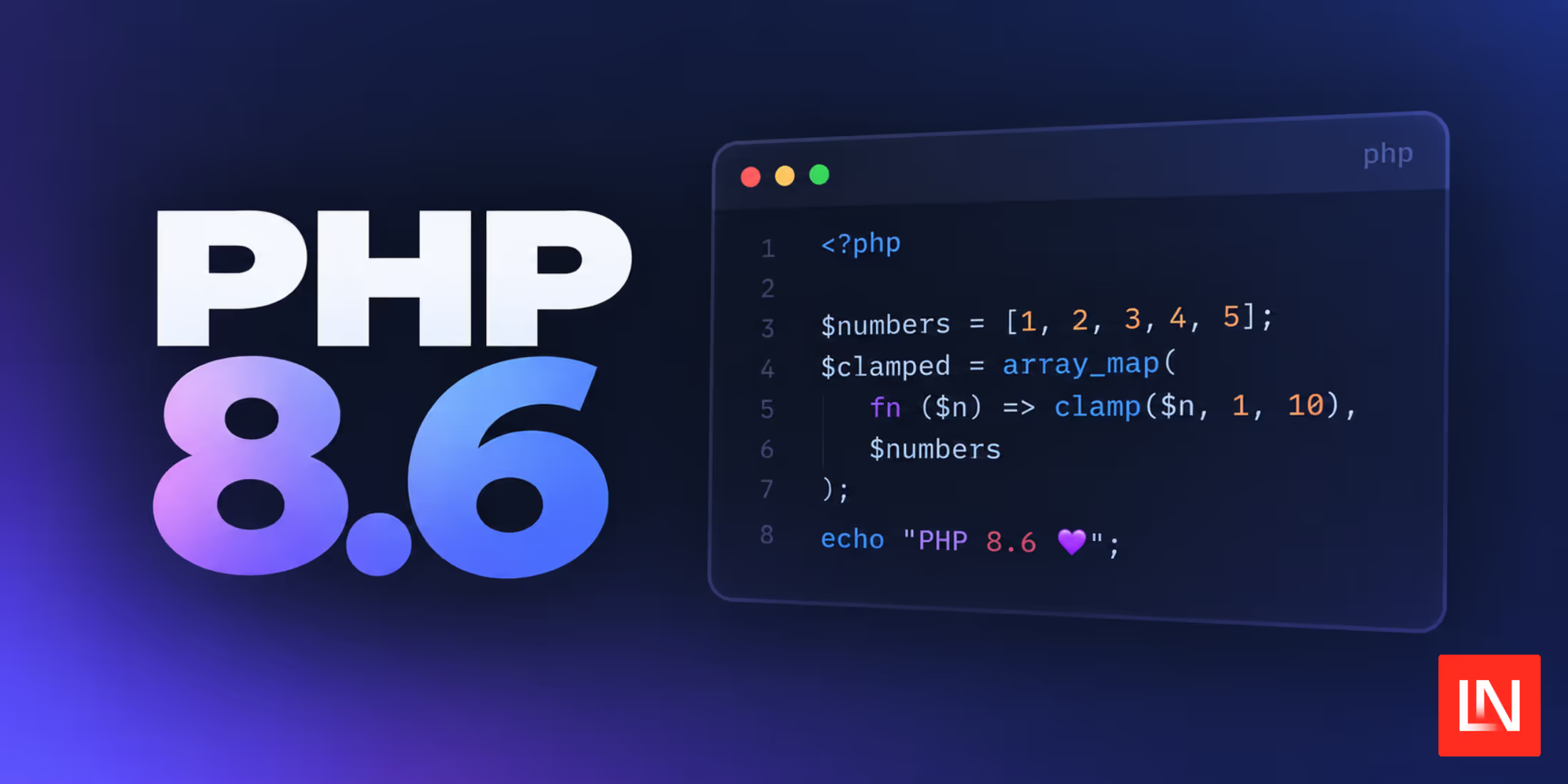
PHP 8.6 also introduces a dedicated clamp() function for restricting a value to a specified range.
For example:
clamp(10, min: 0, max: 100);
// 10

clamp(101, min: 0, max: 100);
// 100

clamp(-1, min: 0, max: 100);
// 0
If the supplied value is already between the minimum and maximum values, it is returned unchanged. Values outside the range are replaced by the closest boundary.
The function supports comparable types, including strings and DateTime objects.
If the minimum value is greater than the maximum value, PHP throws a ValueError.
This provides a clearer alternative to the familiar:
min(max($value, $min), $max)pattern.
PHP 8.6 Introduces Time\Duration
Another important addition is Time\Duration, a final readonly class designed to represent a length of time.
The class supports nanosecond precision, along with factory methods for different time units, arithmetic operations, and comparisons.
For example:
use Time\Duration;

$oneSecond = Duration::fromSeconds(1);

$halfSecond = $oneSecond->divideBy(2);

$total = $oneSecond->add($halfSecond);

$delay = Duration::fromMilliseconds(100)
    ->multiplyBy(2 ** $attempt);

$total > $delay;
Duration values can also be created from ISO 8601 duration strings.
The purpose of this API is to provide PHP with a common duration type that can be shared by core functionality and APIs that need to work with time intervals, rather than relying on loosely typed integers or floating-point values.
Readonly Properties Can Have Default Values
PHP 8.6 removes an existing restriction on readonly properties.
Previously, assigning a default value directly to a readonly property was a compile-time error. PHP 8.6 allows this pattern:
final readonly class CreateBooksTable implements Migration
{
    public string $name = '2026_01_01_create_books_table';
}
This is particularly useful for implementations that need to satisfy get-only interface properties while exposing a fixed value.
The fundamental readonly behavior does not change. Once initialized, the property cannot be reassigned.
Function Parameters Can Have Their Own DocComments
PHP 8.6 makes it possible to place a documentation comment directly above an individual function parameter.
For example:
function search(
    /** Terms to search for in the database */
    string $query,

    /** Maximum number of entries to return */
    int $limit = 10,
): array {
    // ...
}
These comments are available through ReflectionParameter::getDocComment().
The change can make parameter documentation more local and easier for developers to maintain. Static analysis tools and IDEs can also use the information attached directly to the parameter.
New Polling API for Event-Driven Applications
PHP 8.6 adds an Io\Poll namespace that provides a unified interface for operating-system polling mechanisms.
Depending on the platform, the API can work with mechanisms such as:
epollon Linuxkqueueon BSD and macOS- event ports on Solaris
WSAPollon Windows
A basic example looks like this:
use Io\Poll\{Context, Event, StreamPollHandle};

$poll = new Context();

$server = stream_socket_server('tcp://0.0.0.0:8080');

stream_set_blocking($server, false);

$poll->add(
    new StreamPollHandle($server),
    [Event::Read],
    ['type' => 'server']
);

while (true) {
    foreach ($poll->wait(1) as $watcher) {
        if ($watcher->hasTriggered(Event::Read)) {
            // accept the connection
        }
    }
}
The primary motivation described in the RFC is improving internal PHP functionality, including areas such as signal handling and FPM. Userland asynchronous runtimes and event-loop implementations are another potential audience.
A Shared SortDirection Enum
PHP 8.6 adds a global SortDirection enum containing two cases:
SortDirection::Ascending
SortDirection::Descending
At this stage, PHP’s core APIs do not yet accept the enum directly.
The goal is to provide a common type that libraries can use instead of creating their own ascending/descending enums. Query builders are one example of where such a shared type could be useful:
$query->orderBy(
    'created_at',
    SortDirection::Descending
);
Enums Gain __debugInfo()
PHP 8.6 also changes what enums can do with magic methods by allowing them to implement __debugInfo().
This can be used to customize the information displayed when an enum is passed to var_dump().
For example:
enum Status: int
{
    case Ok = 200;

    public function __debugInfo(): array
    {
        return [
            __CLASS__ . '::' . $this->name . ' = ' . $this->value
        ];
    }
}
The change specifically addresses __debugInfo(), which does not require mutable state.
Stream Error Handling Gets a New Model
PHP 8.6 introduces a more structured approach to errors generated by streams.
A new error_mode stream context option allows applications to choose whether stream errors should behave as warnings, exceptions, or be suppressed.
For example:
$context = stream_context_create([
    'stream' => [
        'error_mode' => StreamErrorMode::Exception,
    ],
]);

try {
    $stream = fopen(
        '/nonexistent/file.txt',
        'r',
        false,
        $context
    );
} catch (StreamException $e) {
    foreach ($e->getErrors() as $error) {
        echo $error->code->name . ': ' . $error->message;
    }
}
The associated stream error system introduces structured StreamError objects through stream_last_errors().
The RFC defines more than 50 semantic error codes through the StreamErrorCode enum.
This provides developers with more information about what went wrong than the traditional warning-based approach.
URI Extension Receives More Functionality
PHP 8.5 introduced the URI extension, and PHP 8.6 continues its development with additional functionality.
One of the additions is a set of URI builder classes. They allow developers to construct a URI by setting its individual components before creating the final object.
For example:
$uri = new Uri\Rfc3986\UriBuilder()
    ->setScheme('https')
    ->setHost('example.com')
    ->setPath('/foo/bar')
    ->build();
The follow-up changes also introduce methods such as getUriType() and getHostType().
There are additional functions for percent-encoding individual URI components as well.
More Secure Defaults for Native PHP Sessions
PHP 8.6 changes several default php.ini session settings for new installations.
| Setting | Previous Default | PHP 8.6 Default |
|---|---|---|
session.use_strict_mode | 0 | 1 |
session.cookie_httponly | 0 | 1 |
session.cookie_samesite | Unset | Lax |
These defaults affect applications using PHP’s native session system.
The changes enable stricter session handling and more restrictive cookie behavior by default. Applications that depend directly on the previous native-session defaults should review their configuration before upgrading.
For Laravel applications, this change is generally less significant because Laravel manages its session cookies independently.
What PHP 8.6 Means for Developers
PHP 8.6 is more than a collection of small syntax improvements. The release adds functionality at several different levels of the language and runtime.
Developers working with everyday application code may find features such as partial function application, clamp(), readonly property defaults, and parameter DocComments particularly noticeable.
At a lower level, the Duration, stream error handling, URI, and polling APIs provide new building blocks for libraries and frameworks.
The session changes are also worth checking during upgrades, especially for applications that use PHP’s native session functionality and depend on older configuration defaults.
With the feature freeze scheduled for September 22, 2026 and the final release planned for November 19, 2026, PHP 8.6 is now approaching its final development stages.
Developers can use the beta and release-candidate period to test their applications, libraries, and frameworks against the upcoming version before the stable release arrives.